
To provide you with various specifications of piston & plunger pumps products and services

In industries such as oil and gas, chemical processing, and water treatment, the structural configuration of injection pumps directly determines system operational stability and maintenance costs. Triplex and quintuplex plunger pumps are the most common types, with significant differences in flow pulsation, force balance, and mechanical vibration.
1. Definition
A triplex pump is a positive displacement pump that drives three plungers in reciprocating motion. For each revolution of the crankshaft, each plunger completes one suction and discharge cycle, with the three plungers working alternately to achieve continuous delivery. A quintuplex pump drives five plungers in synchronized operation. Compared with the triplex configuration, the quintuplex design increases the number of plungers to raise the discharge frequency per unit time and optimize the instantaneous flow superposition effect, addressing the continuity and stability of fluid delivery under high pressure conditions.
2. Performance Differences
In terms of flow, the triplex pump has fewer plungers, resulting in large instantaneous flow waveform fluctuations and a high pulsation rate. The quintuplex pump has more plungers with smaller phase differences, producing a smoother flow curve and a significantly lower pulsation rate, which reduces pressure surges. In terms of force balance, the triplex structure achieves essentially balanced torque but has relatively large radial force fluctuations. The quintuplex structure optimizes inertia force cancellation through a symmetrical layout, making the alternating loads on the crankshaft and bearings more uniform and improving operational stability. In addition, the quintuplex pump exhibits significantly lower mechanical vibration and noise than the triplex pump, helping to extend the service life of seals and wearing parts — but its structure is more complex and its manufacturing cost is higher.
| Triplex Pump | Quintuplex Pump | |
| Number of Plungers | 3 | 5 |
| Flow Pulsation | Relatively high | Relatively low |
| Stability | Moderate; prone to pressure surges under high pressure | Excellent; smoother operation with less impact |
| Noise | Relatively high | Relatively low |
| Maintenance | Simple | More complex than the triplex pump |
| Application Conditions | Medium-displacement conditions with moderate requirements for flow smoothness | High pressure, ultra-high-pressure, and scenarios with extremely high requirements for fluid continuity |
3. Selection Criteria
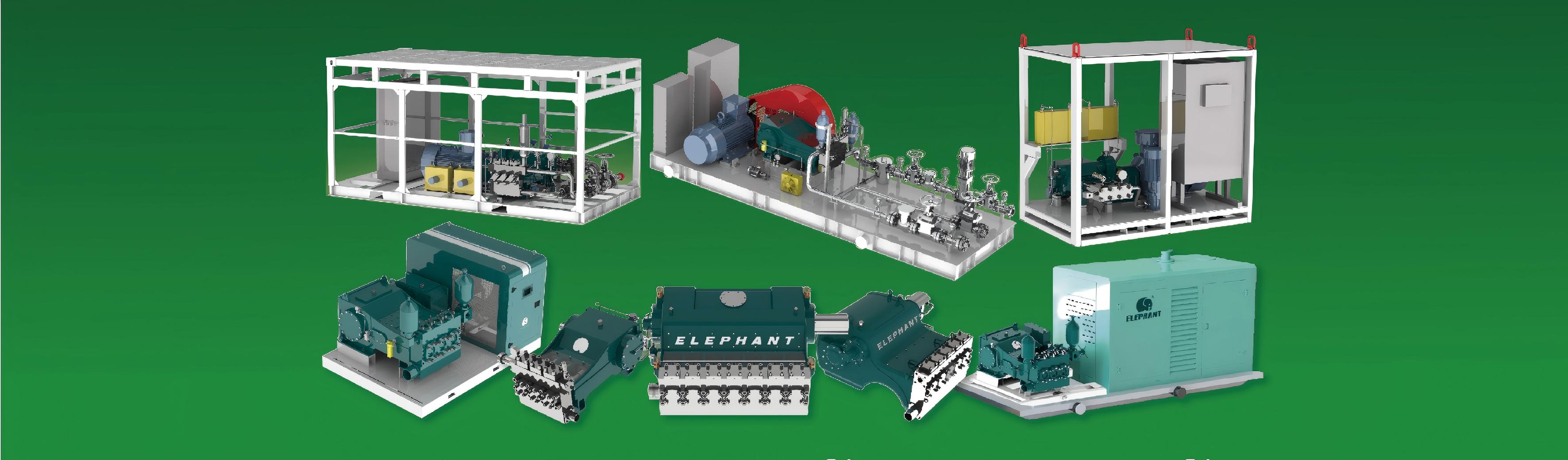
When selecting an injection pump, the key difference between triplex and quintuplex pumps lies in the precise matching of flow requirements, pulsation tolerance, space constraints, and project budget. Elephant Machinery consistently adheres to the API 674 standard, customizing the optimal pump type and skid-mounted solutions.

To provide you with various specifications of piston & plunger pumps products and services
Contact Us
If you are interested in our products, please contact us, we will provide you with suitable services.
 +86 18110351348
 Email: louise.zhang@c-elephant.com
 Address: Room 909, Building 4, No. 109 Software Avenue, Nanjing City, Jiangsu, China</br></br>No. 58 Guan Hua West Road, Jianhu County, Yancheng City, Jiangsu Province, China
Please read on, stay posted, subscribe. and we welcome you to tell us what you think.
We Will Never Share or Sell Your Email. We Also Promise Not to Flood Your Inbox.


 IPv6 network supported