
To provide you with various specifications of piston & plunger pumps products and services

When facing cold weather, the key to selecting the right crude oil transfer pump lies in ensuring stable performance and safe operation while balancing energy efficiency and ease of maintenance.
1. Process and Fluid Characteristics
In cold climates, changes in crude oil processing and fluid properties are key factors in selecting a transfer pump. First is viscosity characteristics: low temperatures increase crude oil viscosity. High-viscosity fluids increase hydraulic losses and shaft power consumption in pumps while reducing efficiency. Second is the pour point. Crude oil in cold regions risks solidification. If the pumping temperature approaches or falls below the pour point, issues like inlet blockages may occur. Additionally, impurities and gas content in crude oil are critical. At low temperatures, water freezes and natural gas escapes, both of which can impair pump operation and shorten its service life.
2. Pump Type Selection
In crude oil transportation operations under cold climates, reciprocating pumps have become a key solution for handling high-viscosity, easily solidifying crude oil due to their unique performance advantages. As a positive displacement pump, reciprocating pumps utilize the reciprocating motion of pistons or plungers within the pump cylinder to periodically alter the working volume of the pump chamber, thereby sucking in and discharging fluid. This characteristic grants them significant advantages when conveying high-viscosity media. Particularly in cold climates where crude oil viscosity increases substantially, they maintain high volumetric efficiency and stable discharge pressure, overcoming pipeline resistance to ensure reliable low-temperature crude oil transportation.
3. Operating Procedures
Before startup, conduct comprehensive preparations to ensure crude oil exhibits good flowability prior to entering the pump. During operation, implement meticulous monitoring and adjustment. Adhere to the principle of “low-load startup with gradual pressure increase,” then adjust to normal load once stability is achieved. Monitor crude oil inlet temperature and viscosity, promptly adjusting heat tracing or flow rate as needed. Enhance monitoring of critical areas, set alarm thresholds, and activate emergency protocols upon anomalies. Conduct regular seal inspections and address leaks promptly. For planned shutdowns: First reduce load, close outlet valves, and disconnect power. If the pump will not be restarted shortly after shutdown, thoroughly purge or clean the pump body and piping. If complete emptying is not feasible, maintain heat tracing.
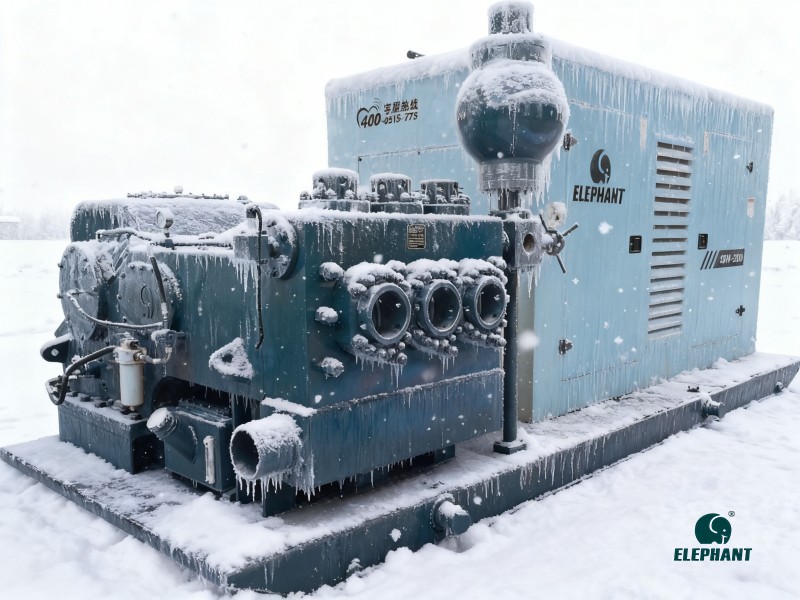
Elephant Machinery crude oil transfer pumps, with their outstanding performance and reliable quality, are the ideal solution for overcoming low-temperature challenges. We adhere to the “product is king” philosophy in our design, committed to providing customers across all industries with convenient, reliable, efficient, and intelligent reciprocating pump products!

To provide you with various specifications of piston & plunger pumps products and services
Contact Us
If you are interested in our products, please contact us, we will provide you with suitable services.
 +86 18110351348
 Email: louise.zhang@c-elephant.com
 Address: Room 909, Building 4, No. 109 Software Avenue, Nanjing City, Jiangsu, China</br></br>No. 58 Guan Hua West Road, Jianhu County, Yancheng City, Jiangsu Province, China
Please read on, stay posted, subscribe. and we welcome you to tell us what you think.
We Will Never Share or Sell Your Email. We Also Promise Not to Flood Your Inbox.


 IPv6 network supported