
To provide you with various specifications of piston & plunger pumps products and services

In reverse osmosis systems, triplex and quintuplex plunger pumps are two widely used equipment types, with clear differences in principle, structure, cost, and application scenarios.
1. Working Principle and Structure
Triplex plunger pumps have a simple structure, relying on three plungers to alternately perform work for pressure output. Flow pulsation is relatively high, and vibration and noise during operation are greater. Quintuplex plunger pumps, with more plungers and higher alternating frequency, deliver smoother flow output with smaller system pressure fluctuations, lower vibration, and reduced noise. This better protects RO membrane elements from pressure fluctuation-related damage.
2. Cost and Maintenance
Triplex plunger pumps have a simpler structure with fewer parts, resulting in lower procurement costs and simpler, more affordable maintenance. Quintuplex plunger pumps, with more plungers and associated valve assemblies, have a more complex structure, higher procurement costs, and increased maintenance complexity and expense.
3. Applications
Triplex plunger pumps are better suited for small-to-medium flow, small-scale RO systems, or budget-constrained projects. Quintuplex plunger pumps are more appropriate for medium-to-large RO projects requiring high flow or high continuity — such as large-scale seawater desalination and industrial pure water production — where they better match the need for stable system operation.
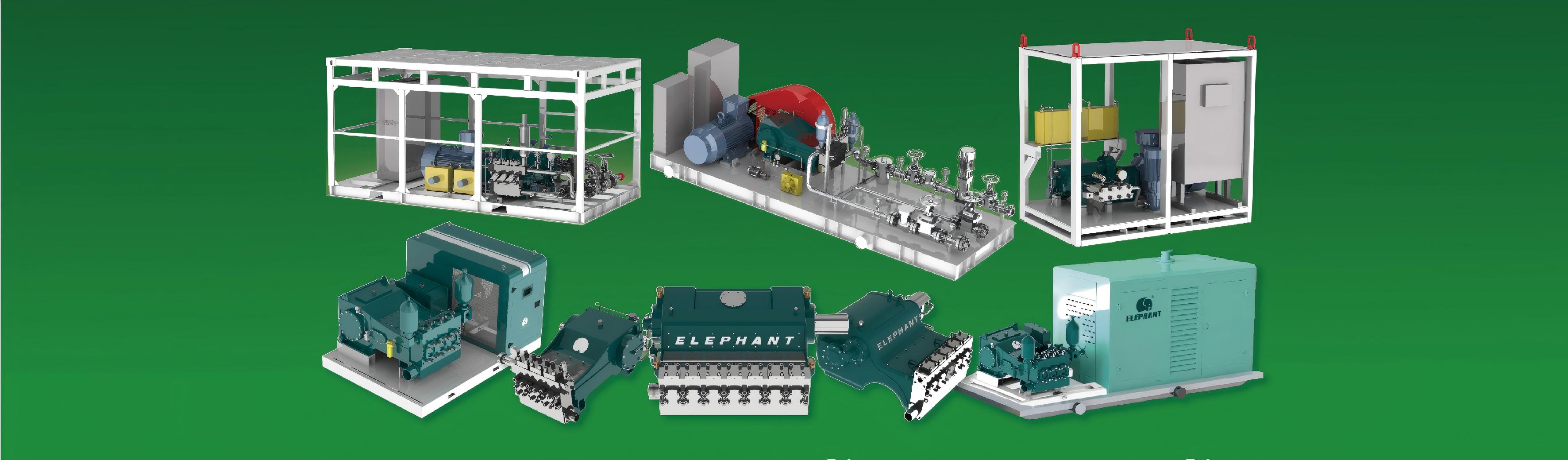
There is no absolute "better" choice between triplex and quintuplex plunger pumps for RO systems — the key is whether the pump matches the project requirements. Triplex pumps are economical, flexible, and easy to maintain, occupying a major share of small-to-medium water treatment markets. Quintuplex pumps, with low pulsation, high stability, and long service life, are the core choice for large-scale high pressure RO projects. Whether for single pumps or complete pump stations, Elephant Machinery offers customized solutions.

To provide you with various specifications of piston & plunger pumps products and services
Contact Us
If you are interested in our products, please contact us, we will provide you with suitable services.
 +86 18110351348
 Email: louise.zhang@c-elephant.com
 Address: Room 909, Building 4, No. 109 Software Avenue, Nanjing City, Jiangsu, China</br></br>No. 58 Guan Hua West Road, Jianhu County, Yancheng City, Jiangsu Province, China
Please read on, stay posted, subscribe. and we welcome you to tell us what you think.
We Will Never Share or Sell Your Email. We Also Promise Not to Flood Your Inbox.


 IPv6 network supported