
To provide you with various specifications of piston & plunger pumps products and services

In boiler feed pump applications, many people believe that only centrifugal pumps are suitable, but plunger pumps can also be used. Under conditions of low flow, high pressure, and stable feed requirements, reciprocating plunger pumps are not only usable but often more suitable than centrifugal pumps.
1. Core Advantages of Plunger Pumps for Boiler feed
Plunger pumps are positive displacement pumps. Their output flow is determined by the plunger stroke and reciprocating frequency and is essentially independent of discharge pressure, so the feed volume remains stable even when boiler load changes and pressure fluctuates. Second, plunger pumps are not limited by rotational speed and can deliver relatively high and stable pressure. High pressure feed for small-capacity boilers does not require multistage impellers for stage-by-stage pressurization, making the pump body more compact. In addition, they have good adaptability to viscosity variations in the medium, and volumetric efficiency remains stable even at higher feed temperatures; with reliable packing or mechanical seals, leakage losses can be reduced.
2. Differences Between Centrifugal Pumps and Plunger Pumps
Centrifugal pumps are suitable for large-flow, medium-to-low pressure conditions. Their flow shifts with pipeline resistance and requires regulating valves or VFDs to maintain feed volume. Plunger pumps forcibly deliver media through volume change, and their flow is almost unaffected by discharge pressure, directly meeting feed requirements in low-flow, high pressure situations. Plunger pumps are usually more efficient than centrifugal pumps of the same parameters under low-flow conditions, are less prone to low-flow cavitation and overheating, and are suitable for long-term continuous operation. However, they have shortcomings such as pulsating output and the need for periodic replacement of wearing parts. These can be mitigated by installing pulsation dampeners and buffer tanks, along with regular inspection and replacement of packing, seals, and other wearing parts. When boiler evaporation capacity is relatively small, feed pressure is relatively high, and load fluctuations are frequent, plunger pumps are worth prioritizing.
3. Under What Conditions Plunger Pumps Are Preferred
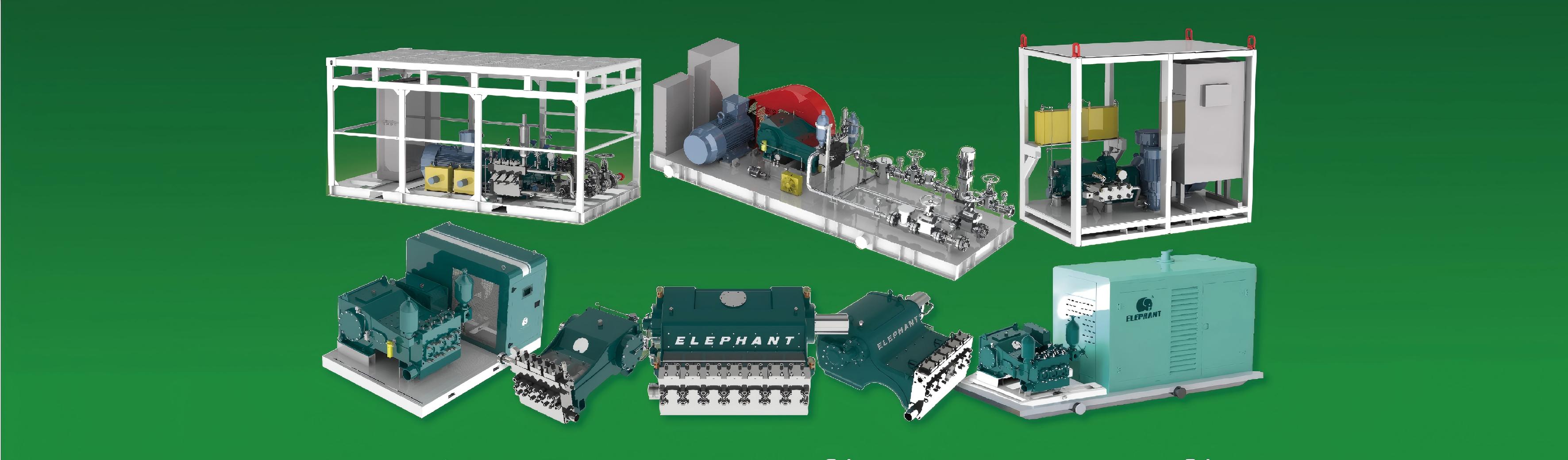
Plunger pumps can serve as boiler feed pumps, offering superior adaptability in low-flow, high pressure scenarios with high feed stability requirements. For large-flow power station boilers, multistage centrifugal pumps remain the mainstream. Elephant Machinery specializes in the production of reciprocating pump skids and supports customized services.

To provide you with various specifications of piston & plunger pumps products and services
Contact Us
If you are interested in our products, please contact us, we will provide you with suitable services.
 +86 18110351348
 Email: louise.zhang@c-elephant.com
 Address: Room 909, Building 4, No. 109 Software Avenue, Nanjing City, Jiangsu, China</br></br>No. 58 Guan Hua West Road, Jianhu County, Yancheng City, Jiangsu Province, China
Please read on, stay posted, subscribe. and we welcome you to tell us what you think.
We Will Never Share or Sell Your Email. We Also Promise Not to Flood Your Inbox.


 IPv6 network supported